Inside the high-priced world of vintage sports photography collecting

[ad_1]

When Henry Yee arrived as a young boy in early 1970s New York City, he did what so many kids in the Big Apple do: He became a Yankees fan.

But his interests extended beyond the Bronx Bombers. Yee became enamored with old photos of New York, images of skyscrapers rising into a skyline built over a century, and life in America’s largest city as it evolved across the decades. He also loved vintage photos of iconic Yankees ballplayers — particularly Babe Ruth. By the 1980s, he was taking photography courses and began buying old photos of New York and of its ballplayers.

“I merged the two interests together,” Yee said. “Back then, there weren’t too many collectors of this stuff.”

And because it was a niche hobby, outside the refined world of fine art photography collecting and the older pastime of trading cards, it was a chaotic wild west of random pricing and no universal system of authentication — was that Ruth photo taken and developed while he was still playing, or developed off a duplicate negative many years later? Or was it a total fake?

“There always was a problem in our hobby,” Yee said. “There was no system for how we sell photos.”

By the 1990s, original vintage sports photography began coming into its own as a serious hobby, and what brought it wider attention was the famed September 1996 auction by Christie’s in New York of hundreds of images from “Baseball” magazine’s photographic archive that spanned 1908 through World War II and featured images of baseball’s greatest players of the era shot by the most famous baseball photographers, such as Charles M. Conlon.

“That’s when a lot of material was put on the market for the first time,” Yee said.

What took the hobby much closer to the far more structured universe of graded trading cards was Yee and a couple of collector friends, Marshall Fogel and Khyber Oser, assembling the 2005 book “A Portrait of Baseball Photography.”

But it wasn’t a coffee table book of vintage images. It systemized how to grade original sports photography.

And thanks to that system, which allows images to be “slabbed” in a plastic holder with condition and grading data like a trading card, the vintage photography hobby has become a genre of sports collectibles that produces eye-popping sales prices that can run into the hundreds of thousands of dollars.

In the book, Yee and the others created what’s known as “The Photo Type Classification System” and in 2007, PSA (one of the major card-grading companies) licensed the system to create an authentication and grading service for old photos. Yee was hired to run PSA’s photo grading and authentication service.

“To get to the next level, someone had to create a system to give it structure. With cards, you had that organization,” Yee said. “There was no third party, which gives it a boost and gave confidence to those not collecting those items to come in. Once it’s graded, it becomes a commodity that can be traded sight unseen.”

The system they developed grades photos as Type I through IV based on the negative and when it was developed from that negative. The best is a Type I photo, which means the image was developed from the original negative within two years of that image being shot, while a Type II photo is made from the original negative after two years from the negative’s creation.

Type III and Type IV photos are made from duplicate negatives, not the original, and are graded as either within two years of the duplicate negative’s creation or after two years. Those have much less value than Type I and II.

The system is now the foundation of original sports photography buying and selling.

“Took a few years to get momentum, and by 2012-13 it started picking up,” Yee said. “It was shocking to us that it was so widely accepted. You had a framework that allowed the hobby to grow.”

Unlike trading card collectors, original photography buyers expect some wear and tear or editorial marks — grease pencil lines for cropping, agency and filing stamps, notations, paper captions, etc. — on the physical images because the photos were used in practical ways and were not intended as collectibles. And if the marks came from a noted photographer, that could add further provenance and value to the image.

“People appreciate photos that were practically used and have the evidence of behind-the-scenes editorial work,” said Oser, Yee’s co-author and now the director of vintage memorabilia and photography at Goldin Auctions. “That’s not a liability, that’s not a detriment. … For now, at least, condition is secondary.”


Original sports photography has been growing in popularity on the shoulders of the wider collectibles surge that’s been underway for several years, particularly among trading cards that have seen some sell for as much as $12 million.

“Original photography has benefitted from the card boom,” said Robert Edward Auctions president Brian Dwyer.

Earlier this month, Robert Edward Auctions sold a Type 1 Josh Gibson photo from the 1940s when he was with the Homestead Grays, an image used for his 1950-51 Toleteros rookie card, for $150,000. In the same auction, a circa 1913 original photo of “Shoeless” Joe Jackson of the Cleveland Naps, graded Type 1 and shot by Conlon, sold for $132,000 while a Type 1 1947 Jackie Robinson rookie photo — taken the day after he broke baseball’s racial color barrier as a Brooklyn Dodger — sold for $32,400, the auction house said.

Jackie Robinson


This Type I photo of Jackie Robinson, taken one day after he broke MLB’s color barrier, sold for $32,400, Robert Edward Auctions said. (Courtesy of Robert Edward Auctions)

“We’re seeing the number of photographs come to market increase, but also the number of people bidding increase,” Dwyer said.

Like with cards, rarity drives interest and price, and photos have a more defined era of physical availability than cards. Photographers were limited by their film stock — a camera held only so much film — until digital photography started to become widespread in the 1990s and shooters could take literally endless numbers of photos.

“The rarity factor is gone,” said Rob Rosen, the vice president of sales and consignments at Heritage Auctions.

Hence, original sports images starting with the rise of baseball (and photography itself) around the time of the American Civil War through the end of the 1980s is the general collecting period.

What most often drives price are the celebrity of the player, the age and rarity of the photo under the classification system, and if the image has historical significance linked to a milestone event.

“The first million-dollar photo … turned out to be a 1951 Bowman card-used photo (of Mickey Mantle), I think in a private sale,” Oser said. “Six-figure photos are more and more common, and we will certainly be seeing more million-dollar photos.”

Who took the photo also can significantly goose value.

One such shooter was Conlon, who took an estimated 30,000 baseball photos until his retirement in 1942. His archive of more than 7,400 fragile glass plate and other negatives sold through Heritage Auctions in 2016 for $1.79 million.

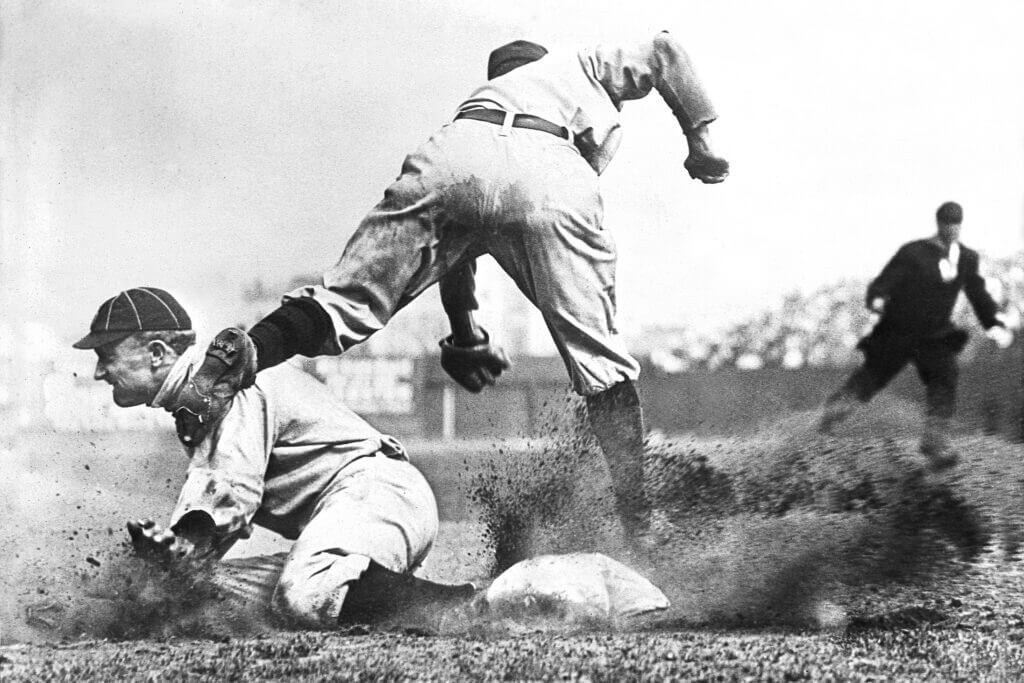
Conlon, who mostly took portrait shots of players, is perhaps best known for an action photo of Detroit’s grim-faced Ty Cobb sliding into third base on July 23, 1910, at New York’s Hilltop Park — the Highlanders’ home stadium until 1912, a year before they became the Yankees — with infielder Jimmy Austin failing to tag him amid a small explosion of dirt around the bag.

An original image developed by Conlon off the negative he shot that day for the New York Evening Telegram sold for $390,000 via Robert Edward Auctions in December 2020.

Even outside the major auction houses, vintage original sports photos are priced at big numbers.

On eBay as of this writing, there’s a PSA-graded Type I 1923 photo of Lou Gehrig that’s possibly the earliest photo of him in a Yankees uniform, and it’s listed at $500,000 with 49 people labeled as watching the listing. Next after that is a listing for a 1919 Babe Ruth photo for $125,000.

Auctioneers said modern sports images taken from negatives sell for much less than the vintage stuff, but value can still be found from early images of top-tier athletes such as Michael Jordan, particularly of the photo used for his much-sought 1986 Fleer rookie card.

While loose, framed, or mounted vintage photos used to be the only way they were sold for years, the ability to get images authenticated and graded in plastic holders (known as slabs) streamlined the hobby, with PSA as the only major firm doing such work.

“Slabbing always helps everything,” Rosen said. “We’ve sold some (original photos) for half a million dollars.”

The hobby isn’t limited to enormously expensive cards. Collectors can buy lower-graded photos for much cheaper prices, even under $100, but famous players may still be pricey even at the lesser type levels.

“Collectors underappreciated Type II and III photos for many years, and now you see Type II and IIIs being affordable alternatives to important historical images,” Oser said. “The value is there now. We are selling Ruth and Gehrig Type IIIs in the thousands of dollars.”

And much like the trading card world’s scandals, original sports photography has experienced its share of fraud and swindlers.

For example, the baseball photo archive of Chicago’s George Brace, who died in 2002, was sold for $1.35 million in 2012 but the deal ended up in lawsuits over non-payment, and the buyer, vintage news and sports photos and memorabilia collector John Rogers, in 2017 pleaded guilty to running a fraudulent operation and was sentenced to 12 years in federal prison and ordered to pay $23 million in restitution.

“There’s a seedy underbelly to baseball photography,” Oser said. “All these industries had their wild west period before professional authentication became the sheriff in town.”

Authentication is intended to help offset deception as the hobby matures. PSA has invested in resources and staffing as sports photography collecting has continued to grow, Yee said, with more space devoted to his department and a dozen staffers working under him.

“We have grown double every year for the past five years, in submissions and revenue,” Yee said. He didn’t disclose financial specifics.

Babe Ruth


Babe Ruth photos, like this Type I from the 1910’s, are the star attraction. “He is the guy in our hobby, the king,” Henry Yee says. (Courtesy of Robert Edward Auctions)

PSA is owned by Collectors Universe, which since its 1986 founding has created a number of sports and non-sports collectibles third-party authentication and grading services. Billionaire New York Mets owner Steve Cohen led an investment group’s purchase of Collectors Universe for $850 million in early 2021 and then bought Goldin Auctions as a standalone business several months later for an undisclosed sum.

That means PSA and one of the major auction houses are linked, which can raise eyebrows, but the photo grading system has been widely accepted across the industry. Trust is critical.

The authentication process is rooted in experience, Yee said, and practical research and technical investigation with powerful microscopes and other technology. In addition to basic eye tests, PSA has a library of thousands of photo paper samples and hundreds of photo agency stamps against which researchers can index an image. Yee calls it a fossil record and noted, “the paper doesn’t lie.”

“You see enough of something, you know right away. There are signs to look for. It comes from experience,” Yee said. “We can identify a photo right away. Some of it, we can’t. We’re still learning.”


Baseball remains the most popular sport among submissions and collectors, Yee said, but there’s been an uptick in other sports, including football, basketball, hockey and soccer, in recent years.

“The most expensive photographs are going to be baseball,” Yee said. “It’s always been that way. It’s always vintage baseball.”

The most money for single vintage images mirrors what’s the big driver in baseball cards: rookies.

“(That) is where the market has matured,” Yee said. “That gap has widened so much, with the rookie images selling for 10, 20 times as much (as later photos of players). People have started to realize that the early images are the hardest to find.”

What’s the so-called white whale of old baseball photos?

“The holy grail image is probably the Honus Wagner image,” Yee said. “It probably would blow past $5 million.” The auctioneers and others agreed.

Boston photographer Carl Horner shot Wagner in a studio around 1902 and the portrait was later used for the famed T206 Wagner “tobacco” card from 1909 that has been one of the most famous and expensive rare cards of all time. A few prints of the Wagner photo have sold for thousands of dollars in varying conditions, and the original image is said to be rarer than the trading card (a Wagner T206 sold in 2021 for $6.6 million).

Babe Ruth remains the most popular player among vintage photo collectors, Yee said, and in February a 1915 image of The Babe sold for $468,000 via Robert Edward Auctions.

“He is the guy in our hobby, the king,” Yee said.

What vintage sports photography is missing that the trading card industry relies upon, particularly for the most rare and expensive items, is population reports. Those are lists of graded things and their sales prices — easy to do with cards because of known print runs and other data from manufacturers and collectors. But with photos, it’s usually impossible to know how many prints may have been made off a glass plate negative.

While PSA is working on some yet-to-be-disclosed efforts in that vein, true pop reports may be impossible, Yee said.

“The big challenge is cataloging it,” he said. “I don’t know if it’s logically possible and economically feasible.”

And the future of vintage sports photography collecting?

It’s obviously in the best interest of PSA and auction houses to be publicly optimistic, but it’s true that the overall collectibles boom — estimated to hit $35 billion this year — has continued and is expected to for some time. While any collectibles genre is subject to market forces and the whims of the public (hello and goodbye, sports NFTs) high-end commodities such as fine art, wine, cars, stamps, etc., have traditionally retained their value in the face of inflation and recessions. There are only so many Conlon and Brace Type I images left.

“The best of the best stuff will always continue to go up. It’s a finite amount of stuff,” Yee said.

go-deeper

GO DEEPER

State of the sports card boom: After sky-high surge, is market still healthy?

(Top photo: Charles M. Conlon / Sporting News via Getty Images Archive via Getty Images)


[ad_2]
Cassy Athena’s NBA photography path: A Nick Young meme, LeBron, the White House and more

[ad_1]

Cassy Athena remembers the moment her life changed.

During her junior year at Cal State Northridge, she was diagnosed with a brain tumor. The life-threatening obstacle forced her to reconsider her career aspirations and restart her life. After she recovered, she pursued photography full-time, emerging as one of the best and most well-connected photographers in the NBA world.

“It just kept taking me somewhere,” Athena told The Athletic of her passion for photography. “I just didn’t know where it was going to take me.”

Athena’s photography skills have taken her from covering the early days of the Drew League to China, and also to Washington, D.C., for the Warriors’ championship ceremony.

She has been a trailblazer in sports photography, particularly for women who, she believes, are still underrepresented in the space.

“I feel like the first three, four years of my career, if not more, were just proving that I was there for the right reasons,” Athena said. “And that’s just based on me being a female. At times, it would get very frustrating. There were certain brands and certain people that wanted me out of certain spaces, and they would use that against me. … And a lot of negative rumors, a lot of bad stuff. It would upset me and frustrate me so much. The one thing that I always did have, though, is the players always had my back. … I wouldn’t be here if those guys didn’t help me have the chance to do it.

“So now, I feel like I’m in a better position where I can help other women and help people enter this space and show them, like, ‘Hey, you can be here; you can shoot.’”

In Episode 1 of Season 2 of “Stargazing,” The Athletic’s NBA culture podcast, Athena spoke about her meteoric rise as a photographer, creating the famous Nick Young meme and shooting LeBron James, Stephen Curry and the game’s biggest stars. She also discussed overcoming her brain tumor, covering the Warriors’ championship ceremony at the White House and the advice given to aspiring photographers, among other topics.

Here’s parts of our conversation.

Editor’s note: Questions and answers have been edited for clarity.


You got your big break during the 2011 lockout. How did you start connecting with players and getting into the NBA space?

Around the time I was diagnosed with my tumor, like right before it, I had been working as a cashier at a sporting goods store, and I saved up. I mean, I was probably making $8 an hour. I saved up every dollar possible and bought my first intro professional camera from Costco — and it was not even that great. And then after my tumor, I kind of put the camera aside for a while.

But after I was recovering and I kind of got that passion reignited, I started trying to take pictures again and trying to see what I enjoyed taking pictures of. So, I would continue taking pictures. … Back in the day, there was a big Lakers message board I was a part of. I was a very big Lakers fan, and somebody on there had mentioned there was a league called the Drew League and that there were a bunch of NBA players (playing).

So, I drove down there by myself. Nobody ended up coming. I was the only person that showed up. I had brought my little point-and-shoot camera, and I just sat in the crowd and in the background and tried to take the best pictures I could. My first day at the Drew League, it was James Harden, O.J. Mayo, DeMar DeRozan, Nick Young, JaVale McGee. There were so many different players that, at that time, were really pretty great in the NBA. So, I think from Day 1, I was hooked, and I was trying to figure out, how can I get involved more.

One thing I did notice: There were no photographers at the Drew league. There was a couple of video guys. … So, I reached out to the Drew League on Twitter. I said, “Hey, here’s some pictures I got last week. I would love to come back again.” And they told me, “Well, we can’t pay you, but we’ll save you a seat in the front row.” To me, that’s all I wanted. I didn’t want anything else. I think that was a big reason why I had a lot more access, because a lot of photography at the time, sports photographers, they were hired by the league or by an outlet. If they’re not getting paid, why are they going to spend eight or nine hours on the weekend taking free photos for something that didn’t even make sense at the time? There was no social media other than Facebook and Twitter. Instagram hadn’t even been a thing. … So, it just kind of came out of nowhere, but it ended up taking my career and starting it off, really.

When did you come up with your watermark? You were the first person I saw doing that on social media. And then it kind of took off and became a badge of honor for NBA players to post one of your photos on their Instagram feed. How did you come up with it? Obviously, you do great work, but I think that little detail really took it to another level for you.

Yeah, I started doing that in college, actually, when it was just Facebook. I would take pictures and I’d send them to the guys, and I would put it in the bottom corner. Unfortunately, a lot of people didn’t like watermarks. They would just crop it off. To me, I was just, like, “Man, I spent all my hard-earned money on buying the camera, driving there, taking photos, editing photos for free. The least I should get is credit.” So then, I started trying to experiment with maybe putting the watermark in the middle of the photo. Then people were like, “Oh, it’s too much.” And then, “OK, maybe I’ll put it next to your face.”

So over the years, my watermark would evolve. I would experiment a lot. When it first started, it was a straight line. It said photography. It had plumeria flowers. And then every year, I would kind of make it a little more simplistic and not as obnoxious. I never wanted a watermark that was obnoxious because, at the time, watermarks would be all over photos. I wanted it to be very subtle, because when I was studying art in college, when an artist paints something, it’s not worth anything until they sign it. So to me, I felt like this was almost my signature on my photo.

To me, I felt, like, how can I place my watermark in a way where it kind of flows with the photo so you can still know I shot it, but it’s not taking away from the image? I had so much pushback, mainly from other photographers. They would all tell me, “This is ugly. Nobody’s going to want to post your photos because of your watermark.” To me, I just felt like it was my art. But also, I needed to protect myself because on the internet, stuff is very easily moved around and used without permission. I felt like if I had my watermark — and I’m pretty stubborn, so I feel like I’m just going to do it — I don’t care if every photographer thinks it’s ugly. The players weren’t complaining.

And then, it started to become, “Oh, who shot this? Oh, who’s Cassy? Oh, I want a photo by her.” It started turning into this thing, especially in the basketball world, where people now want my watermark. I get paid now to keep my watermark on photos. So, it’s kind of full circle how it’s all turned into my brand. But I feel like at the beginning, I wasn’t really thinking of long term. I was just like, “This is a cool idea, and I’m just going to run with it.”

I’ve always wondered if you wish you had your watermark on the Nick Young meme, which you created. When did that take off? How did that go viral? 

In 2013, I realized I had this really cool opportunity having all this access to such cool NBA players. And I noticed at the time, mainstream media was not covering the things that I was covering to the point where I had companies telling me, “Nobody cares about what players are doing off the court. Nobody cares what they’re wearing.” And I was just like, “OK, let me find a way to show it and put it on my own channels.” I had been very familiar with editing video, filming video. I went to school for a lot of that stuff. So, I decided to start a web series, and I called it “Thru The Lens.” I would follow NBA players for a day in their life, and I was going to edit it and post it on YouTube — and whatever happens, happens.

The first player I decided to reach out to was Nick Young. Nick was the best person I could have thought of to start with, because he obviously has a great personality and he just gave me all access. (We) linked up for the day. His assistant was there, and the three of us just hung around L.A. At one point, he took us to his mom’s house. His mom is funnier than him. She’s just got the greatest personality. She was just telling us childhood stories about Nick. Then she mentioned this one story about how he ran into a player at a local park and how Nick was playing good, but how he needed to take the game more serious, that he was a clown back then.

When she said that, it was like the fastest look ever, if you watch the actual video, it was really quick. But then when I started editing it, going back to my motion graphics, visual effects background, I was like, “How can I add little funny graphics throughout the video?” That one moment I was like, “I have to add question marks.”

I think it probably took me a year to edit it and get it right, the whole episode, because it was my first one. Once I got it uploaded, I think within a few months I just remember going on Twitter one time, and then I saw somebody post a meme of that screenshot. I was like, “Wait a second. That’s my Nick Young meme.” And then it just went viral. I feel like the second I saw it was maybe around April 2014. By Christmastime, it was everywhere. Every single person was using it. And then when people found out it was a video clip, it went viral all over again, because now it was fun that this moment that you love actually has a video, as well. That’s why I don’t have (my) watermark, because it has a “Thru The Lens” watermark in the corner of the video. People just cropped it off.

I would have never thought a video of all things would be the most viral thing I’ve shot. … Nick has been interviewed multiple times, and he always gives me credit, too. It was a really cool moment, but I feel like a lot of people for at least two or three years were like, “She created the Nick Young meme.” And I’m like, “I have so much more work I’m doing.” But yeah, that’s my most viral, honestly. I’ve embraced it.

Is there a photo of yours that LeBron (James) posted that had a real impact on your social following or interaction?

I flew to New York for Fashion Week with Victor Oladipo, and I got there really early and I hit up (trainer) Chris Brickley. I had never been to one of his runs out there. I said, “Hey, I’m in New York; can I come to your gym today?” And he was like, “LeBron is going to be here,” and I was like, “Oh, cool.” I had shot LeBron maybe one time the year before, so LeBron was familiar with my work, but I’d never actually met him. When I went to Chris’ gym, there were, like, 10 other photographers. There was a lot of people with their iPhones. LeBron walks in, his bodyguard shuts down everything — no cameras, no cell phones, nothing — and I’m like, “Wait a second.” So, I’m trying to argue back and forth with the bodyguard like, “Hey, I’m not some random photographer.” And he was like, “I don’t care. The answer’s no.” So he goes in the corner and he’s standing in front of LeBron. I’m trying to talk to Chris. Chris is like, “Just leave it alone.” And I’m like, “No, like, I’m not.”

I walked over and I start going back and forth with the bodyguard, like, in a respectful way: “Hey, I didn’t come here with the intent to just shoot LeBron. I came to shoot all these other guys.” There were still, like, 20 other NBA players there. LeBron saw me going back and forth with the bodyguard, and he stands up, walks over, gives me a big hug and says, “Thanks for coming out” and walks away. And I’m in my head, like, “What just happened?” Like, this is wild. But on the outside, I got to remain calm, you know? And then I was like, “We good?” And (the bodyguard is) like, “You’re good.” So, I was the only person allowed to shoot that run.

And then, I got this photo of LeBron dunking, and I posted everything on Instagram, because I still didn’t talk to LeBron. He screenshotted them, reposted them and then gave me photo credit. I wasn’t aware he was wearing a Kith x Versace shorts collaboration; it was Fashion Week and he was out there doing an event with his shoes. So, it just went super viral. I remember Tom Brady was commenting, (as were) all these superstars. And then every media outlet picked it up, and everybody who picked it up, all you see is in the caption, the photo credit, “Cassy Athena photo.” I was already more established in my career, but I feel like getting respect from somebody that is, honestly, one of the greatest players of all time … to me, that felt like a really cool stamp of approval.

Since then, I’ve gotten cooler with him. He moved to L.A. I get to shoot his family a lot. I got to build a cool friendship with the whole family and also get credit. I’m a huge fan of LeBron as a person and a player.

You recently covered the Warriors’ championship ceremony at the White House. How did that come about? What was that experience like?

I was in Washington, D.C., shooting a boxing fight with Gervonta Davis. Then I flew back to L.A., and I got this email, and it said it was from the White House. It said, “The president invites you to come to the Warriors’ ceremony.” I was like, “I was just in D.C.; this has to be some spam email.” I figured somebody knew I was out there and was trying to mess with me. For the invitation, you have to give your Social Security number. I’m like, “This seems like a crazy scam.” So I tried to double-check my facts as much as I could: “It seems legit, you know?” So, I RSVP’d, and I bought a ticket and went back to D.C. a few days later.

It was really cool because the Warriors were playing a game against the Wizards on Monday, which was Martin Luther King Day, and then on Tuesday was the White House. I had no idea what to expect because I wasn’t with the Warriors, I wasn’t with the NBA. I was invited by the White House. There was a girl who had reached out to me from the White House, and she is in charge of working with their brand partnerships and social media. She was the one, I guess, that knew who I was. So me and her connected, and they had to ask for special approval so I could bring my camera in and take pictures.

It was the most surreal, cool experience to be invited to the White House of all places — but not as a photographer for a team, to be invited as a guest by the actual White House. I got to go through a bunch of layers of security, and once I got in, there was a lot of people there that don’t know the Warriors, that maybe had connections to just be at the event. Because of that — and me being really the only person with a camera that could move around, and then being friends with Steph and Draymond (Green) and all the wives and everything — I was able to capture the coolest moments, even though I wasn’t necessarily the photographer for the day. I think I got more access than anybody because I was able to go back to having that trust from everybody and people knowing I was going to take some really cool photos. To me, that was one of the coolest experiences.

What is one piece of advice you’d give to an aspiring photographer coming up in 2023?

It’s tough now because 2023 is a whole different world than when I started. But I would say, the main thing is to have a good attitude and to be consistent and to fall in love with photography. A lot of problems with photographers over the years that have come and gone (are), they get so caught up in trying to shoot the people that have the most followers or who can get them the most attention or who’s the most popular, instead of trying to actually enjoy editing and taking photos and the grind, the process part of it. It’s always exciting when you post a photo and it goes viral and people love it, but (the) process it takes to get to that point of even posting the photo, I think a lot of people don’t realize how much work is involved behind the scenes. I think that’s the biggest part, really falling in love with it and finding what makes you unique.

Don’t try to just copy every other photographer. Find your own style that’s going to make you stand out more. Being a good person, networking and relationships are everything. I mean, I would never make it to this point in my career if it wasn’t for other people that have reached out their hand and helped me, and vice versa, you know? So, relationships are huge.

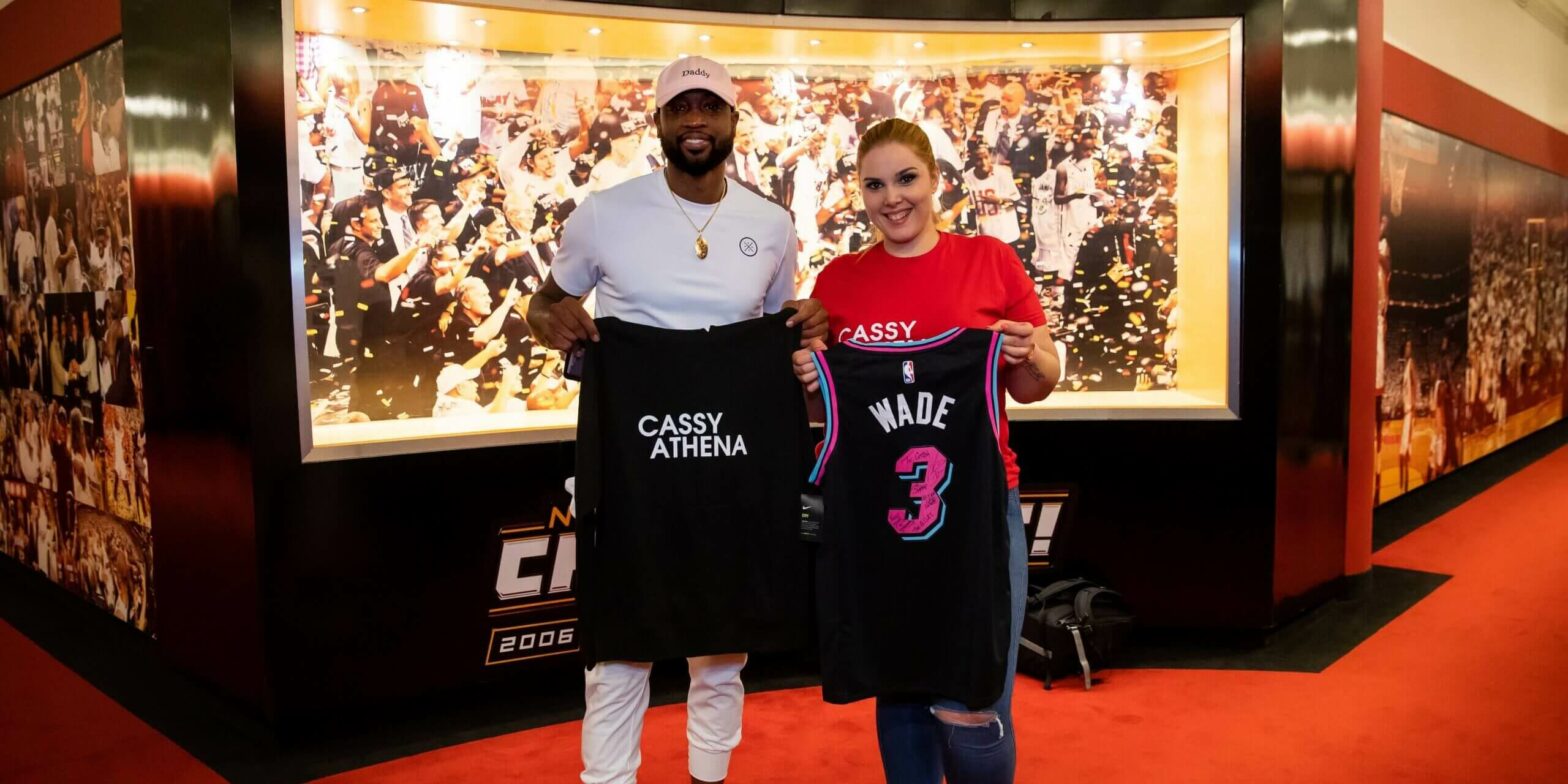
(Photo of Dwyane Wade and Cassy Athena: Cassy Athena / Getty Images)


[ad_2]