Natural Resource Foundation hosts annual nature photo contest | News

[ad_1]

MADISON (WKOW) — A Wisconsin nonprofit is hosting a photo contest to see who took the best nature photo in the state this year.

Natural Resources Foundation of Wisconsin is asking people to submit photos of Wisconsin landscapes and wildlife. 

There will be prizes for first, second and third place as well as people’s choice. There are also bonus categories: landscapes, mammals and people in nature.

First place will get a pair of high-end Swarovski Optik binoculars and their photo features on the NRF’s publication. Second place will win an inflatable kayak, and third place will get a canvas print and a $200 Camera Company gift card. Finally, people’s choice will get a swag bag with a hat, t-shirt and other fun prizes.

Entrants can submit up to four photos.

The contest closes on Nov. 1.

For more information on submission requirements, visit the contest webpage.

[ad_2]

Photography exhibit features work by young people

[ad_1]

HICKORY — This summer the North Carolina Museum of Art partnered with The Salvation Army of Greater Hickory Boys and Girls Club through the Artist Innovation Mentorship outreach program (NCMA AIM) by offering photography classes.

The classes were presented with photographer Jane St. Clair, assisted by artist Melissa Crosson, who is the coordinator/liaison for the NCMA AIM program in the western part of the state.

The community is invited to attend a photography exhibition featuring the Boys and Girls Club Summer Camp participants. The exhibit will feature two or three photographs from each participant and will be open to the public on Thursday, Aug. 10, from 3:15-4:15 p.m. in the fellowship hall of The Salvation Army of Greater Hickory Administrative Building, located at 750 Third Avenue Place. SE, Hickory. Come out to celebrate these students and the art of photography.

The Salvation Army is a global nonprofit organization founded in 1865 by Catherine and William Booth. Every day The Salvation Army of Greater Hickory and High Country strives to meet human needs throughout Alexander, Ashe, Avery, Burke, Caldwell, Catawba, McDowell, Watauga, and Wilkes counties.

To support your local Salvation Army, send contributions to P.O. Box 1167, Hickory, NC 28603, Attention: Andrea Beatty; call 828-322-8061; or donate securely online on The Salvation Army of Hickory website, salvationarmy.org/hickory.

[ad_2]

With land buys, Nebraskan has added on-the-ground conservation to Photo Ark’s visual focus

[ad_1]

Joel Sartore celebrated two very visible milestones last month.


magpie

Joel Sartore reached a new milestone in the National Geographic Photo Ark last month, adding his 14,000th species. The Indochinese green magpie, named Jolie, is at the Los Angeles Zoo. She survived being smuggled in a suitcase, with little ability to move, during a flight from Vietnam.


The Lincoln-based National Geographic photographer added his 14,000th species to the National Geographic Photo Ark, a project he founded in 2005 to document Earth’s biodiversity. The stunning Indochinese green magpie named Jolie, now at the Los Angeles Zoo and Botanical Gardens, was one of only eight birds — out of 93 — to survive a flight from Vietnam in a wildlife trafficker’s suitcases in 2017.

Twenty of Sartore’s photos of endangered species from the Photo Ark were featured on a panel of U.S. postage stamps released to commemorate the 50th anniversary of the Endangered Species Act. One, a piping plover, was photographed near Fremont, Nebraska.

People are also reading…

But Sartore and his wife, Kathy, also have been quietly working on a less visible conservation project.

Over about the past dozen years, the couple have purchased about 5,700 acres of what Joel Sartore called “conservation land” — pastureland dotted with marshes, lakes and native grasses that are home to thousands of birds in warm months — in southern Sheridan County in Nebraska’s Sandhills.

They partner with a local ranch family with a similar conservation ethos. Jaclyn and Blaine Wilson, the daughter-father pair who operate the nearby Wilson Flying Diamond Ranch, and another family member lease and run cattle on the grazeable acres. The Wilson ranch was awarded Nebraska’s first-ever Leopold Conservation Award by the Sand County Foundation in 2006.


stamps

Twenty of Joel Sartore’s photos of endangered species for the National Geographic Photo Ark were featured in a panel of stamps that the U.S. Postal Service issued last month to mark the 50th anniversary of the Endangered Species Act.


“It’s a lovely place, and it’s something I feel like I can do for conservation in a way that Photo Ark doesn’t do,” Sartore said. “This is real on-the-ground stuff.”

He and his wife, he said, have financed the purchases themselves by working hard and saving their money over the years. Sartore is known for his frugality and hard work; as a youth in Ralston, he worked at gas stations and a record store, mowed lawns and cleaned aquariums. Early in their marriage, he said, the couple bought, fixed up and sold two small farms in the Lincoln area, doing much of the work themselves.

The couple plan to put the land in trust so it’s maintained at its current level of use by people who have been there for generations, Sartore said. They also want to protect its abundant water from people who might come calling from drier regions.

“It’s a lifetime of work, and this is what we ended up with,” he said. “If we can afford it, we’d love to do it again.”

They also have purchased a couple of smaller conservation properties in eastern Nebraska — two small farms, one near Bennet and the other near Ceresco, as well as a pasture near Valparaiso. They’ve implemented conservation measures on all three, instituting rotational grazing on the pasture, as well as restoring ponds and planting native grasses and wildflowers for birds and pollinating insects.

But the bulk of their conservation purchases, he said, have been in Sheridan County. They bought their first pasture in the area in about 2011. They added larger parcels in 2019 and 2022, according to Sheridan County Assessor’s Office records, purchasing a total of about 4,400 acres for approximately $3.56 million.

Sartore said the couple focuses on wet ground — land a rancher can’t make much of a living on but that yields big conservation returns, land that provides habitat for waterfowl and upland ground for long-billed curlews, a species in decline. It’s also less costly acre-for-acre than farmland.

“These are not places you buy if you really want to invest your money,” he said.

Jaclyn Wilson recalls getting an email from Sartore in March 2020, about the time COVID-19 was taking off. Wilson, a fifth-generation rancher, knew who he was. Her grandparents gave her family a National Geographic subscription for Christmas each year. Its arrival in the mail was a monthly highlight.

In his email, Sartore counted himself among Wilson’s biggest fans. She has been writing opinion columns for the Midwest Messenger, an ag-focused publication, for more than a decade.

Wilson invited him to visit the ranch, and Sartore spent several days there in August 2020. He brought a biologist, and they collected insects, identifying 100-some species, including some new to the Photo Ark and a beetle that previously hadn’t been found that far north.

“It was really cool stuff,” Wilson said.

She took him to the property he’d previously purchased, and he asked if there were similar properties available in the area. Sartore’s more recent purchases include Thompson Lake, which is known for waterfowl, and Snow Lake, which features waterfowl and curlews and also is known for salamanders.

Sartore recalled that he’d read a real estate listing about the salamanders, which mentioned them as a commodity that could be seined and sold for fishing bait.

He said Dan Fogell, a herpetologist and life sciences instructor at Southeast Community College in Lincoln, has identified them as a subspecies of the Western tiger salamander called the Gray tiger salamander. They’re usually found a bit farther north, Fogell told him, but they’ve been found in multiple places in the Sandhills as well.


sartore sandhills

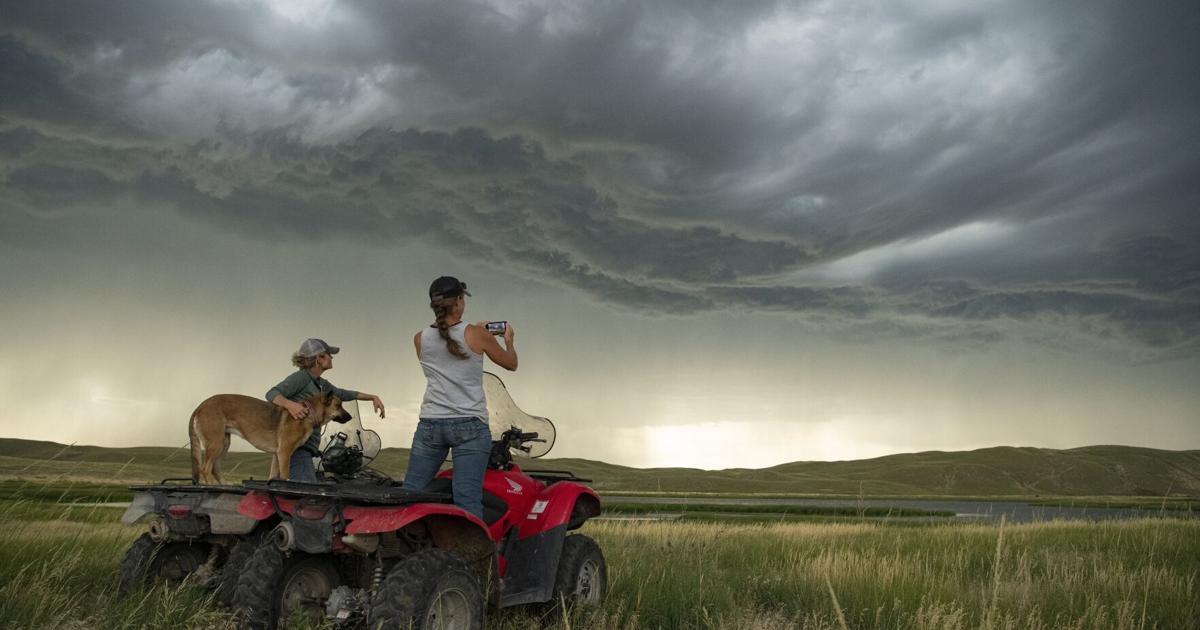
Jaclyn Wilson, left, and friend Amy Sandeen watch a thunderstorm roll in from the first pasture that Joel and Kathy Sartore purchased in the Sandhills for conservation more than a decade ago. Wilson, a fifth-generation rancher, operates the nearby Wilson Ranch near Lakeside, Nebraska, with her father, Blaine Wilson. Wilson family members run cattle on the Sartores’ pastures.


Wilson said her grandparents emphasized conservation and passed down those lessons to later generations. They planted thousands of trees and adopted management practices that are now widely recommended. They raised game birds for release to enhance local populations and only cut hay at certain times of the year. The family also has worked to restore a wetland on its property. In recent years, the ranch has begun selling beef direct to consumers through its website.

Both the family and Sartore encourage scientists to study wildlife on their properties. One project, Wilson said, involved collecting sonar data on bat populations. Another researcher studied dung beetles. Sartore noted that the Nebraska Game and Parks Commission bands geese in the area each spring.

“It’s been really neat that we’ve been able to bridge that gap with some of the conservationists he works with,” Wilson said.

Sartore said he likes the Sandhills because it polices itself. Run too many cattle for too long, and it creates bare spots, or blowouts.

He said he doesn’t have to worry about the condition of the land where he has made his purchases. It was, and continues to be, managed by people who care.

But the family’s purchases offer a chance to keep the most beautiful places from being developed after they’re gone, he said. Many of natural areas where he collected tadpoles and crayfish as a kid in Ralston now are under concrete.

Sartore takes other conservation measures, too, including maintaining a pollinator garden at his Lincoln office, complete with signs explaining what it is and how to do it at home. The FAQ section on his website — joelsartore.com — includes tips on how anyone can help save species, from properly insulating their homes to conserve energy to cutting back on single-use plastic items like grocery bags.

“We just think nature needs a break, and it has to be intentional,” he said.

Meanwhile, Sartore, who’s nearing 61, continues what he calls his “day job” with Photo Ark, a job he wants to continue as long as he can. For many species, the photographs are the only vetted and accurate record of their existence. His son, Cole, now accompanies him on overseas shoots.

He said he may hit 15,000 species by the end of the year. Initially, he estimated that the project would come in around 12,000 species, based on the number in the world’s accredited zoos and aquariums at the time. But those have grown in number, and he’ll go anyplace animals are in human care, from fish markets to wildlife rehabilitation facilities. He could see the Ark possibly reaching 20,000 species.

“It’s meant to inspire (people to) want to save nature and save themselves at the same time,” he said.

[ad_2]

Ansel Adams exhibit mulls nature amid a changing climate | Art

[ad_1]

Ansel Adams created some of the definitive photographs of the Western American landscape long before climate change threatened to obliterate it forever. Born in San Francisco in 1902, Adams is best remembered for his lush black-and-white pictures of the Yosemite Valley and the Southwest, as well as for his role as an educator who influenced generations of photographers after him.

Now, the de Young — the site of Adams’s first exhibition in 1932 — hosts “Ansel Adams in Our Time,” a major retrospective organized in partnership with the Museum of Fine Arts, Boston, examining the artist’s legacy in relationship with the work of 23 contemporary environmental photographers breaking new ground in the genre.

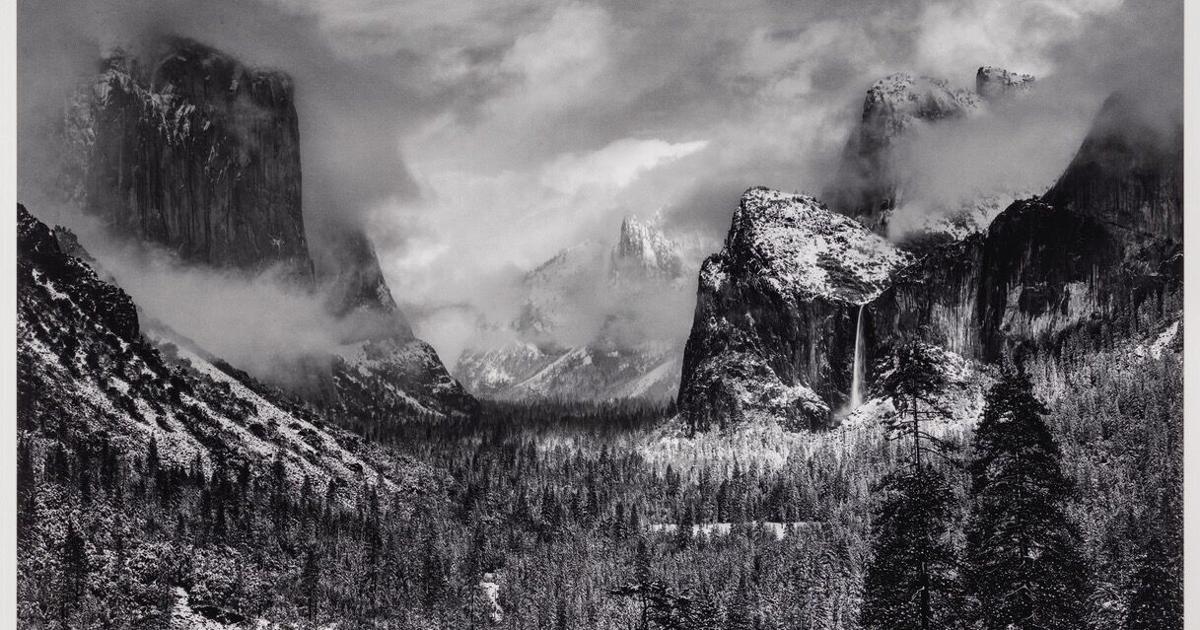
While the exhibition is full of iconic Adams shots, like “Clearing Winter Storm,” c. 1937, or “Moon and Half Dome,” 1960, both made in Yosemite National Park and many deep cuts, the artist’s work is only a jumping off point.

Richard Misrach’s “Golden Gate Bridge” series, shot from the back porch of his home in the Berkeley Hills, responds directly to Adams’s “The Golden Gate Before the Bridge,” 1932, a breathtaking view of the mouth of the Bay between the Presidio and Marin Headlands – sans bridge. Mark Klett implements collage to converse with Adams and other seminal landscape photographers. The titular view of “View from the handrail at Glacier Point overlook, connecting views from Ansel Adams to Carleton Watkins,” 2003, photographed in color by Klett, is overlaid with collage elements snipped from Adams and Watkins’s earlier black-and-white pictures.

By returning to the source, both artists play to photography’s chronological promise, revealing how much – and how little – has changed.

Others are more concerned with interrogating the act of looking itself, challenging the ubiquity of the White male gaze. Catherine Opie’s landscapes, like “Untitled #1 (Yellowstone Valley),” 2015, respond to and contradict Adams in almost every way: colorful and completely out of focus. Binh Danh’s daguerreotypes of Yosemite, a printing process using a highly copper surface, mirror the viewer in the image.

Both Opie and Dahn’s pictures raise the question of how who looks changes what they see, placing the viewer inside the landscapes they photograph. In fact, the traditional absence of humans from many landscape photographers’ work, including Adams’s, presents a bit of cognitive dissonance: The human footprint is increasingly present in nature, from population growth to climate change, while the particular absence of people in Western landscapes carries colonialist connotations. What you don’t see is just as important as what you do.

Some photographers of Adams’s era attempted more ethnographic projects, like Adam Clark Vroman’s 19th-century playing card sets, illustrated with photographs of Native Americans and sold as souvenirs. Contrast that with Will Wilson’s contemporary portraits of Native Americans like “Nakotah LaRance,” 2012, a young man carrying a portable video game system and a comic book, or Wilson’s own self-portrait “How the West is One,” 2014. Wilson’s diptych represents the artist on both sides: on one, Wilson is dressed in Indigenous cultural garb; on the other, he’s dressed like a cowboy, each staring gravely into his reflection’s eyes. Here, we get a clear view of what’s missing from the supposedly objective presentation of the hauntingly empty landscape.

While Adams’s vision of the West became ubiquitous, it was itself far from objective. Credited with several advancements on the technical side of photography, he studiously crafted many of his images post-production, often combining multiple negatives and using all the darkroom trickery available to him to create impossibly breathtaking views. These technological experimentations were cutting edge at the time, and his work continues to be at home in the company of similarly daring experimenters.

Chris McCaw and Meghann Riepenhoff both play fast and loose with the negative, accentuating the illustrative — even painterly — quality photography can possess. McCaw, who builds his own giant cameras, outfitted with periscope lenses, makes long-exposure photographs in which the trajectory of the sun burns its way across paper negatives over time. Riepenhoff’s pieces are contact prints made by exposing photo-sensitive paper to various natural phenomena, like ice, in addition to light. It’s a level of integration with nature Adams never achieved, embedding nature into their work in an inversion of human’s impact on their

environment.

In one of his rare, urban landscapes, “Housing Development, San Bruno Mountains, San Francisco,” 1966, Adams turns his own lens on the direct impact of development, a zigzag of prefab homes tearing through the hillside. Compared to Adams’s earlier nature shots, this feels like a slap in the face, forcing the viewer to confront the degradation of the landscape. There’s a way in which all of Adams’s photos could be considered depictions of humanity’s impact on the land, and the continued impact on the land is fully displayed by his contemporary counterparts.

Mitch Epstein approaches environmentalism through absurdism. In “Altamont Pass Wind Farm, California,” 2007, the arid wind farm serves as a backdrop for a group of golfers playing on the green course that abuts it. “Signal Hill, Long Beach, California,” 2007, offers a scene of an oil pump wedged between homes in a suburban neighborhood, showcasing the intersection of industrial greed, urban sprawl and willful ignorance. Laura McPhee’s diptych “Early Spring (Peeling Bark in Rain),” 2008, is a view into a dense forest of burned trees, the soot-black bark of each trunk peeling away to uncover new growth beneath. It’s a heartbreaking record of wildfire damage, with a hint of a promising future.

The beauty of the natural world has grown bittersweet. Every picture in the exhibition is gorgeous, sublime enough to teach the Hudson River School a lesson, but they’re hard to look at without recalling recent and increasing environmental travesties in the Bay Area and beyond.

By avoiding the sort of didactics often present in climate activism, Adams and company remind us what we have to lose by showing us why we love it, doing so without sacrificing any of the complex dynamics present in humanity’s relationship to the land. These pictures aren’t for posterity: they’re a reminder that time is running out.
[ad_2]

Bloomington-raised poet, photographer talks Midwest stories for TEDx

[ad_1]

Is ‘flyover country’ an appropriate moniker for the Midwestern U.S., or other overlooked places in the world? Through photography & poetry, this talk explores that question through inspection of the overlooked or the avoided: rust; thunderstorms; work; everyday people doing everyday things; politics; social class; et cetera.

A lifelong Midwesterner, Justin Hamm is the author of four poetry collections, two poetry chapbooks, and a book of photographs. His most recent book is Drinking Guinness With the Dead: Poems 2007-2021 (Spartan Press 2022) . . .


BLOOMINGTON — Most Midwesterners, like Justin Hamm, can say they once had childhood dreams of leaving their hometowns for somewhere “things are really happening.”

Now 42, Hamm is speaking about how he changed his perspective on life in the Midwest through the power of poetry and lens of a camera. The 1998 graduate of Normal West Community High School was featured in a TEDxOshkosh talk published Wednesday on YouTube, titled, “The American Midwest: A Story in Poems & Photographs.”


011522-blm-loc-1poet

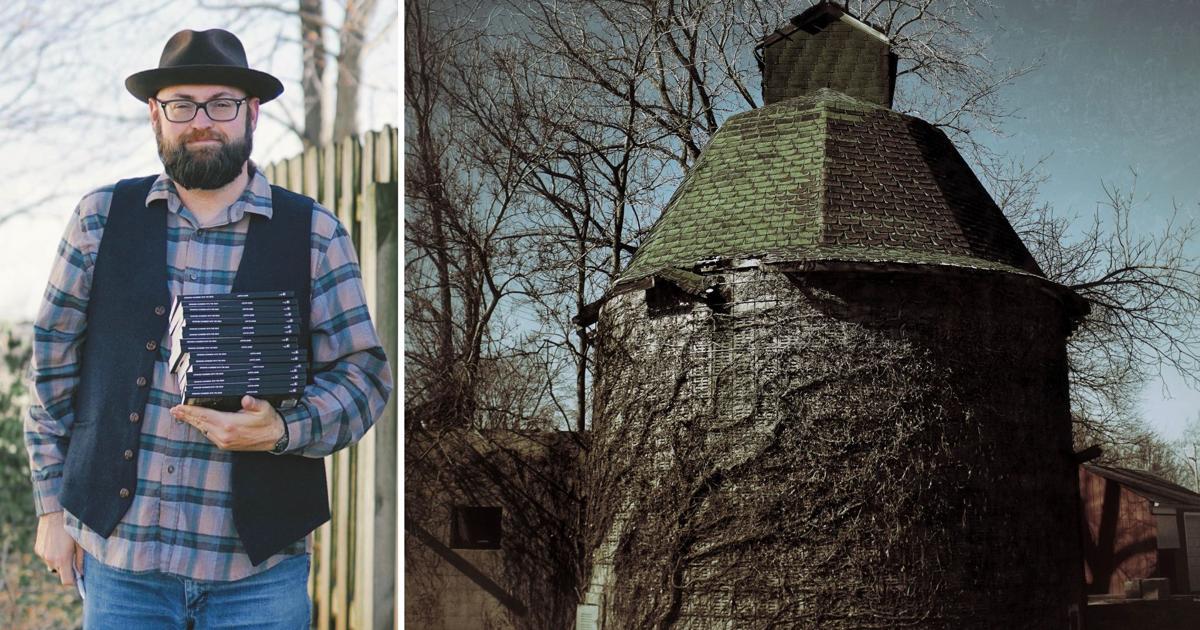
Bloomington-native Justin Hamm, in Mexico, Missouri, holds a stack of his poetry books in this provided photo from 2022. He was recently featured in a TEDxOshkosh talk.


Hamm, who mainly grew up in Bloomington, theorized before listeners in November 2022 in Oshkosh, Wisconsin, that “there really is no such place as nowhere.

Everywhere is somewhere, and everywhere has a story to (it) we can uncover if you learn to use the poet’s or the photographer’s eye.”

Pushing back against negative stereotypes about the region, like the “flyover country” label, he said the Midwest has kept him artistically busy and interested. Some of the prose recited by Hamm told of the beauty of a rust, “the mysteries of barn wood” and forgetting his jockstrap for a double-header baseball game.


Read this Wednesday, June 10, 1998 file story covering a Normal West High School baseball game against Olney High School, including quotes by then-catcher Justin Hamm.


The former catcher for the Normal Wildcats chanted verses of “Until Death Do Us Part,” as photo slides showing the exterior of Keller’s Iron Skillet & Catering in Bloomington were displayed. He drew parallels in his poem “Rust — Or Perhaps Fine Art” between decay and impressionist painting.

In a Friday interview with The Pantagraph, he said he tries to take photographs that would make good poems: “Quiet little scenes that illustrate something about the region.”


Watch now: Normal West student, ‘train fanatic’ publishes book in ‘Images of Rail’ series

“Experience another life.”

Hamm explained the title of his latest poetry book, “Drinking Guinness with the Dead.” Drawing from three other previously released books, it was released in March 2022 by Spartan Press, and contains material dated between 2007 and 2021. Hamm said it also has a “book’s worth” of new poems to go with it.

He said one meaning of the title refers to having a few beverages before revising older material. It was weird reading back in time, and he didn’t seem to care or relate to it at first. But Hamm said he didn’t want that to be the case.

He said going back also made him realize he wasn’t doing enough to publicize that work.

Reflecting on his piece titled “A real team effort,” he said he hoped to capture awfully embarrassing moments of adolescence and bring them to life. Hamm said many have told him they can relate.


011522-blm-loc-3poet

Poet-photographer and former Bloomington resident Justin Hamm is shown in this 2021 self-portrait.


“They get to experience another life for a while,” he said.

That teleportation also extends to his photography work. Showing stills of rusted-out cars, he said countless people have told them that model was the first they owned.

At another poetry reading and photography showing, Hamm said two farmers lectured him about why a particular style of corn crib was built in Central Illinois but not in South Dakota, because of the immigrants who settled in those regions.


011522-blm-loc-3poet

Shown in this 2019 photo provided by poet and photographer Justin Hamm, formerly of Bloomington, is a Central Illinois barn.


See with different eyes

Hamm said he never left the Midwest. He said he got married and went to school in the region, and moved to Mexico, Missouri, where he currently works as a librarian for Eugene Fields Elementary School. He’s a husband to his wife Mel Hamm, and father to two daughters: Abbey, 13, and 9-year-old Sophie Hamm.

He attended MacMurray College in Jacksonville to play baseball, also where he met his wife, and said he got more involved in the English department after hurting his arm. Hamm also explored fiction writing, but said he knew he “was always a poet at heart.”


Tucker drew on Bloomington-Normal ties for his science fiction, mysteries

Coming back to poetry over time, he said he found success. He did his masters of fine arts degree at Southern Illinois University at Carbondale, and followed another Bloomington native who was coaching wrestling in Mexico, Missouri.

Knowing his best friend “Martin” would be there and his wife liked the school district, he said it was a good landing destination. Hamm said they haven’t found any reason to relocate since they moved there in 2005.

Hamm also edited his startup literary magazine, Museum of Americana, for 10 years. Then in 2019, his poem “Goodbye, Sancho Panza“ was studied by 50,000 students worldwide through the World Scholar’s Cup curriculum.


Bloomington couple hope book, school visits improve birthmark awareness

Around 2009, Hamm said his mother died and he had his first child. That’s when he said he realized his roots are in the Midwest, and leaving was not a certainty. Hamm said he thought he’d better start trying to see things with different eyes.

“Everything that happens in this region is a microcosm of the biggest conflicts and struggles, and also the most beautiful things in the world,” he said.

He said these experiences teach us lessons in human psychology, social interactions and the dichotomy of rural versus urban. There are many different perspectives to view through stories and images, he said, like immigrant experiences and sights of beautiful landscapes.

“When I started to stop and pay attention, I realized how deep that history really is,” said Hamm.

To keep up with Hamm, and read or purchase his work, go to justinhamm.net.

Contact Brendan Denison at (309) 820-3238. Follow Brendan Denison on Twitter: @BrendanDenison


[ad_2]