If you often find yourself stressing about what to give loved ones as gifts for the holidays or for their birthdays, your smartphone may hold all the answers. And no, we’re not talking about online shopping; we’re talking about all the amazing photos it holds.
Nowadays, almost everyone has several thousand photos on their smartphone. Whether it’s vacation photos, landscapes, or family photos, you most likely own an impressive collection. And what’s even more fun, you don’t have to worry much about the photo quality. Just select the ones that look best, and half of your gift is done.
If you’re still puzzled by the idea, here are a few amazing gifts you could make using just the photos in your smartphone:
Offer a Unique Mug
If you’re preparing a gift for someone close to you (a friend, a sibling, or a partner), a mug can be an endearing and sweet gift. But, to make it even more endearing, you can use a funny picture of the person and print it on the mug. This way, whenever they drink coffee or tea, they’ll see the picture and think of you, or they’ll smile because the picture reminds them of a funny situation.
If you’re stuck browsing through the hundreds of photos you have of the person (or with them), try looking for inspiration in other people’s ideas for a gift – you might strike gold!
Create Personalized Calendars
A one of a kind calendar can be an amazing gift for grandparents, parents, or even office colleagues, depending on the pictures you decide to use. For instance, if you want to make a calendar for your grandparents or parents, they’ll love seeing your face plastered over each month of the year, but your colleagues may not be happy about that.
However, if you use a group photo with your colleagues for the cover, you can still create a beautiful and thoughtful gift for everyone at the office.
Make a Photo Puzzle
What better way to reminisce about your amazing summer vacation than to turn some of the most gorgeous landscape photographs on your phone into a puzzle? True, the images need to be high-quality (especially if you want a big puzzle with 1000+ pieces), but most smartphones nowadays shoot in HD (at least).
Plus, you can add valuable information to the image, such as the date and the destination of your vacation. This way, you can piece the puzzle together and turn it into a wall painting or art. As a result, you’ll have a gorgeous painting reminding you of a wonderful vacation you literally pieced together.
A Digital Photo Frame
If you’re not into arts and crafts but still want to impress your giftee, a digital photo frame can be a great option. However, the costs will be a bit higher than with the other ideas since you have to buy the frame.
However, there are plenty of options, so it all depends on your preferences and budget. Once you have the frame, you can upload your favorite pictures and decide on the presentation pattern and transitions.
This one’s a great gift for anyone who likes technology because it’s easy to use, looks amazing on a bookshelf or a desk, and can be refreshed with new images. It’s also a great way to keep track of your relationship by adding new pictures each year!
Wrap Up
The images we store on our smartphones or online can be a treasure for customized gifts, so don’t forget about them! Sort them out, edit the ones that need a bit of help, and bring them into the real world by turning them into unique gifts.
Design fails can come in many forms. Sometimes it’s an unintentional reference or a simple typo that could have been avoided with closer proofreading. And sometimes an attempt to do something clever falls apart in the execution.
This one falls into the latter category. I get the idea – I think. The travel brand wanted to show a sudden transformation in the face of a young woman as she goes from travelling vicariously by staring at people’s social media feeds to taking a selfie of her own on holiday in Europe. A few pixels of space between the two images might have made that work. Maybe. But as it is, the result looks like something very different.
Suffice it to say, this ad isn’t going to make it to our pick of the best print adverts. It’s more likely ripe for inclusion in the worst design fails of 2022.
fly_to_europe_and_have_a_stroke from r/CrappyDesign
Shared by u/DucksToo22 (opens in new tab), the ad has gone down a storm on Reddit’s r/CrappyDesign community, already generating 600 comments. “I can’t believe that a marketing department somewhere looked at this image and gave it the thumbs up,” one person said. Others feel for the model involved “Can you imagine being super excited that you were asked to be a model… and then six months later…” one person said.
But others disagree. “The advertising agency that produced this did a perfect job,” one person suggested. “Produce an ad that they will make fun of for its mistakes on social media. The exposure alone will get us more views than the ad as originally intended.”
And some aren’t at all surprised that the piece saw the light of day. “As a tourism marketing dude, I think you are overestimating how many people are involved in these things,” one person said. “There are legit chances that the person who made the art is the same that approves it, post it and create a text to go with the Instagram post.”
Whats better than Orion in the Winter sky? Nothing that’s what!
Saturday here in Kansas we had a rare clear night with the temperature above 5 degrees F, wind below 40 mph and just a tiny sliver of moon. It was a perfect night to go out and hunt Orion the Hunter!
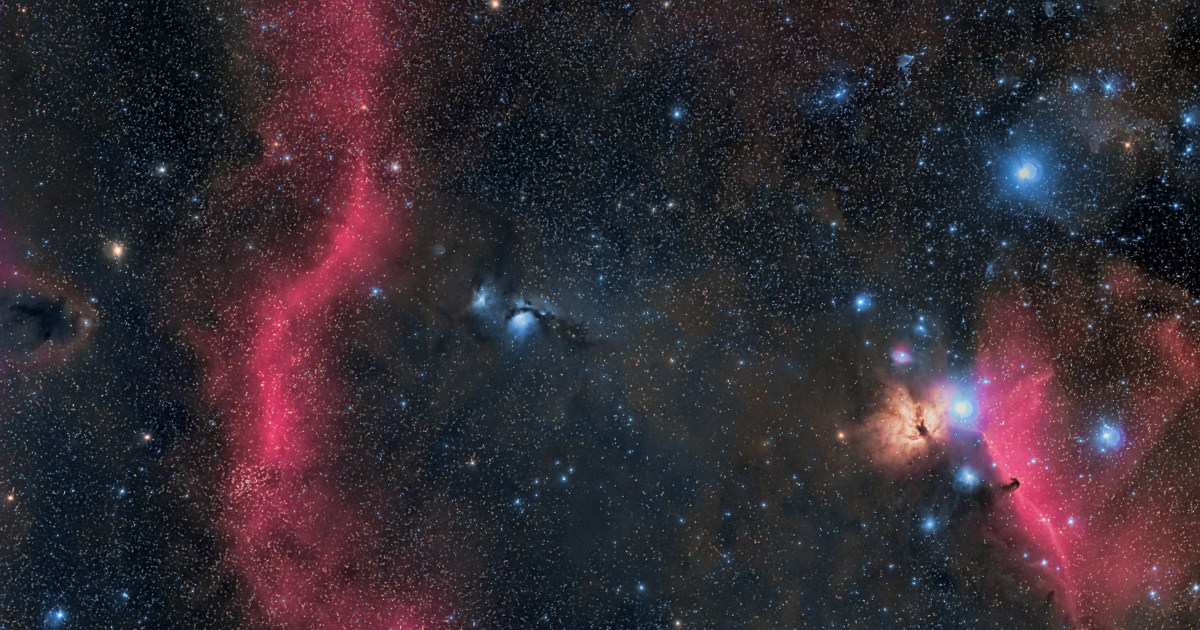
In this shot, I managed to bag the Horsehead Nebula (right), M78 or Messier 78 (center left blue), and a piece of the large area around Orion called Barnard’s Loop.
There are so many fantastic areas of Hydrogen Alpha Emissions (called Ha) and super bright Nebulas in this region. These are that areas you see as pink in the image. The HA emission is 656 nanometers which is a bit above the color red on the light spectrum. Here a bit from Wikipedia on H-Alpha emissions.
H-alpha (Hα) is a specific deep-red visible spectral line in the Balmer series with a wavelength of 656.28 nm; it occurs when a hydrogen electron falls from its third to second lowest energy level. H-alpha light is important to astronomers as it is emitted by many emission nebulae and can be used to observe features in the Sun‘s atmosphere, including solar prominences and the chromosphere.
H-Alpha emissions are typically emitted by dense nebulas which are the star-forming regions of galaxies. Trillions of tons of dust and remnants of supernova explosions gather together like a snowball rolling downhill slowly gathering more and more material until gravity compresses the material to the point it heats to ignition. Then in a massive explosion that jets out leftover material and creates a Herbig-Haro object that is a protostar.
All the pink areas and dark dust areas are stars in evolution, from a clump of dust to the largest star. All represented in a single picture.
Enjoy! Plus check out the cool way to focus at night I created too!
For much of the 20th century, LifeMagazine conquered mass media as the primary visual source for current events. From 1936 to 1972, the magazine presented the public with carefully crafted images that captured real-world social and political narratives. Henry Luce, the publication’s founder, was able to expose readers to a wide variety of images outside of their immediate community, shaping discussions about contemporary issues in the process. As the Museum of Fine Arts puts it in its new exhibit, “with its visually revolutionary brand of storytelling, Life fundamentally shaped how its readers understood photography and how they experienced and remembered events.”
The exhibit, “Life Magazine and the Power of Photography,” documents these crucial photographs, stories and histories. Through its well-crafted presentation of original negatives, contact sheets, vintage photographs and internal communications, viewers are taken on an immersive journey into not only the magazine’s history but America’s as well.
Walking into the exhibition, viewers are invited to sit down beside a vintage coffee table surrounded by suburban wallpaper reminiscent of the 1950s and flip through issues of Life from that era. Unlike most museum exhibitions, in this instance, the MFA is directly inviting viewers to interact with the exhibition’s subject of study. For young audiences not familiar with Life or its general structure, this display provides a fantastic opportunity to connect with and understand the publication’s appeal before continuing.
Subsequent rooms cover the publication’s founding and its early history. Viewers have the opportunity to read Henry Luce’s original telegrams describing the magazine’s purpose and analyze early “dummy” versions and drafts of Life’s first issue. Prints by Margaret Bourke-White, one of Life’s first photographers and its very first female photographer, are displayed, including “Fort Peck Dam, Montana,” the 1936 image that became the magazine’s first cover. Other iconic images on display include J.R. Eyerman’s “Audience watches movie wearing 3-D spectacles” and Yousuf Karsh’s famous portrait of Winston Churchill sitting with his cane and glaring into the camera with his powerful stare.
These photographs are complemented by a variety of text panels surrounding each section of the hall, which provide insight into the photographers and the processes involved in capturing some of the 20th century’s most influential images. Rather than simply presenting recognizable pictures to the viewer, the exhibit makes an effort to educate visitors about the journalistic process — describing how stories were assigned, how agency photographers composed their own shots and how scripts were involved in these visual narratives. Visitors who download the MFA’s mobile app have the opportunity to listen to interviews with Life reporters who share their first-person experiences with the photographs and stories presented.
Apart from simply describing these artifacts, “Life Magazine and the Power of Photography” also explores the magazine’s focus on the deeper, heavier themes that came to define its lasting influence. Photographs by W. Eugene Smith, grouped together, highlight the healthcare challenges faced by Black women in the poverty-stricken South. Images captured by Larry Burrows illustrate America’s harsh timeline of war — especially the Vietnam years and the trauma they inflicted. The visual groupings highlight the importance of these histories beyond the magazine itself and educate visitors about how these major topics were received and documented in American media.
Though it glorifies some of Life’s successes, the exhibit also carefully considers the magazine’s shortcomings too, especially regarding its “predominately white, male, middle-class perspective on politics, daily life, and culture.” In a section featuring images of civil rights protests, the museum makes an effort to highlight some of the inaccuracies promoted by Life, such as the magazine’s failure to describe police as aggressors in images of racially-motivated violence. The exhibit is conscious of the white, suburban bias of Life’s audience and of the people interviewed in stories as well. Presented with a holistic view of the publication, museumgoers are reminded that often, in journalism, key perspectives are excluded from mainstream narratives.
Beyond the magazine’s actual contents, the exhibit features several installations by contemporary artists Alfredo Jaar, Alexandra Bell and Julia Wachtel. Their artwork extends the dialogue presented in “Life Magazine and the Power of Photography” by highlighting contemporary shortcomings in journalism, including its biases and problematic narratives.
“Life Magazine and the Power of Photography” is one of the most interesting and insightful MFA exhibits in recent history. From the photos displayed to the supplementary materials provided, the exhibit tells an exciting narrative about the history of modern America and its relationship with media.
“Life Magazine and the Power of Photography” is open to the public from Oct. 9 through Jan. 16, 2023 at the Museum of Fine Arts in Boston.
Sunset at Mt Sass de Putia in the Dolomites in northern Itally
Earlier this fall I spent 10 days touring the Dolomites. The Dolomites, designated by UNESCO as a World Heritage site, are located in northern Italy and are part of the Alps. The jagged mountain peaks, reflections on the lakes, fall color, and churches are particularly stunning. The sunrises and sunsets can be spectacular. Some of the churches with their ornate architecture are centuries old and but still in surprisingly good condition given their age. The weather in the area is extremely unpredictable.
The image in this post is of Mt Sass de Putia. The day before this image was taken, we visited the area and the entire area including the mountain peak was enshrouded in fog. The mountain peak and the valley below were not visible. I spent the afternoon entertaining myself photographing trees and buildings vanishing in the fog. Prior to our visit our local guides attempted to describe the scenery that we could expect to see. It was difficult to put that in perspective when all you could see was fog.
The next day we returned to the exact same location and the weather was sunny. I was completely blown away by the scenery. I found the scenery more spectacular than described by our guides. The image seen here is of Mt Sass de Putia bathed in the golden light as the sun set. I especially like the mix of warm and cool tones. The color in the cool blue sky and the golden light on the mountain peaks complement each other nicely. My camera did an excellent job of holding detail in the spruce trees. I hope you enjoy this image.
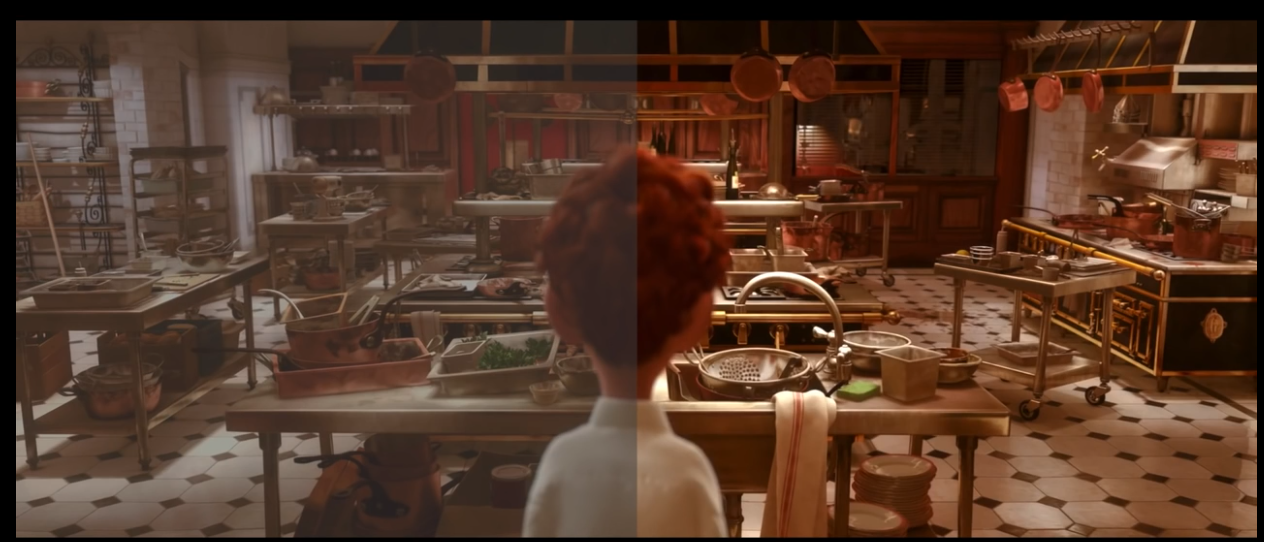
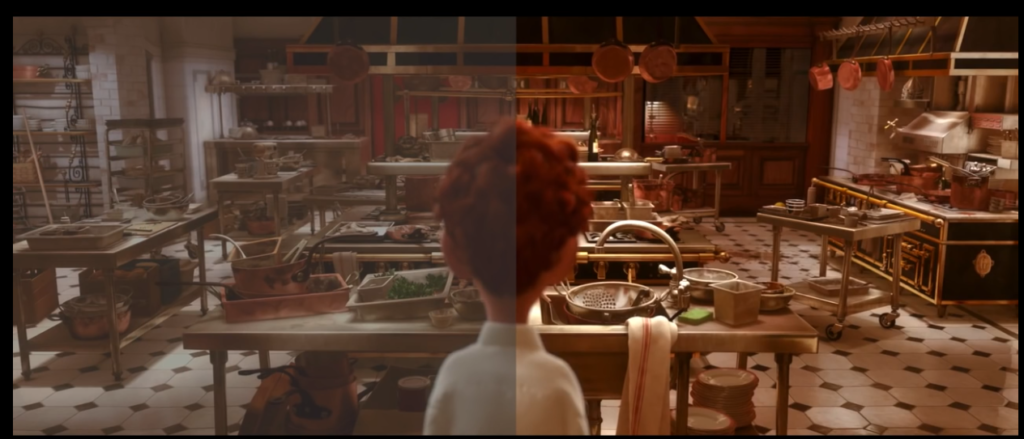
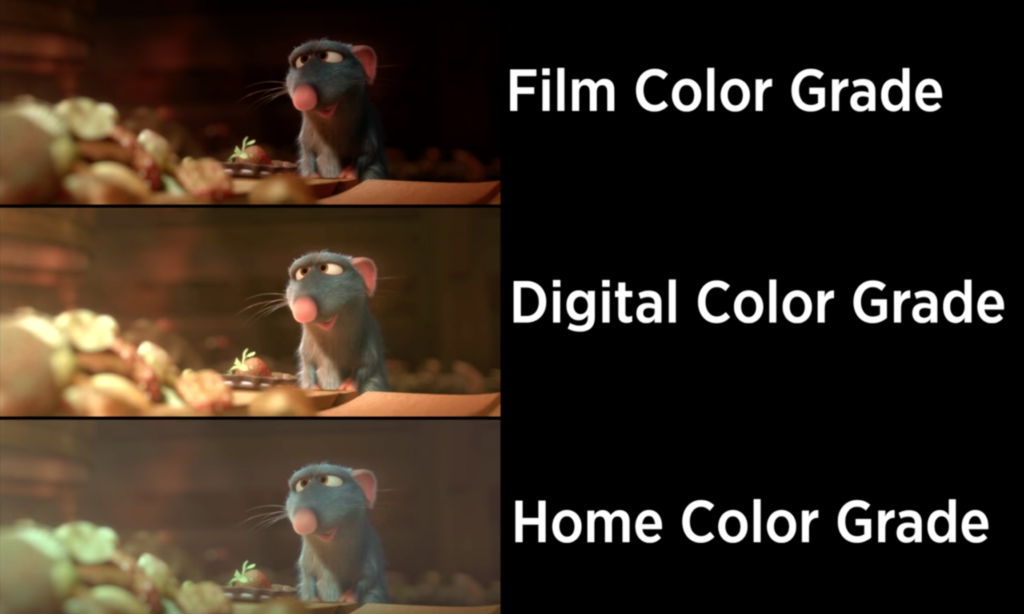
We all know Pixar (Animation Studios) for the funny, witty, touching animation movies. Part of the reason these movies are so good is the focus on excellent story telling. And these stories are told with excellent quality standards and the focus on all the little details. But what does Pixar have to do with astrophotography, I hear you ask. Well, one could make some philosophical point about story telling in (astro)photography I guess, but the real reason we are talking about Pixar here is color and color theory. One of the things Pixar needs to be great at is the use of color in their movies and how it will be perceived by the audience. Pixar even has a ‘color scientist’ to support that and now you are able to learn a lot about color from him. Pixar teamed up with the Kahn Academy and created a course on color science.
I’ve talked about getting the colors right in your astrophotos before and now you can learn more about color from this online course here: Color Science on KhanAcadamy It’s relatively short (it takes around 2 hours to complete) and it covers some great things that is relevant for all of us as (astro)photographers. “Just as dialog, acting, and music are tools filmmakers use to convey meaning and emotion, color can be used to the same effect. But determining “color” is not as simple as saying “red” or “brown” because there are endless shades of color in the visible spectrum. In this lesson, you will learn how color is determined partly by the physics of light and partly by how our brains perceive it.”
As usual for course on the Khan Academy the Color Science course encompasses some nice short videos in which Pixar explains things about color, followed by some questions and practice sections in which you are presented with a tool and you are going to work with color and color grading yourself.
This course on color science is part of ‘Pixar in a Box‘ which covers more topics on animation and it’s great fun and insightful!
In photography, too much light can be a frustrating thing to deal with. There’s generally more than enough light around at lunchtime on a clear summer day, for example, but it’s hard and concentrated, and generally requires a bit of intervention in order to make it work for a picture.
But what about when there’s not very much light at all? How can you make the most of your camera in fading light or even in the middle of the night? While the best professional cameras (opens in new tab) are capable of recording stunning photos even in low light, you’ll need to time your shoot carefully depending on the results you want.
Night photos don’t tend to look their best if they’re taken in the middle of the night. By shooting earlier, when there’s still some color and brightness in the sky, you’ll be able to create more evocative shots, where the indigo-blue twilight hues provide a fitting contrast to the warm glow of streetlights, illuminated buildings and traffic trails (opens in new tab).
(Image credit: Getty Images)
For some types of night photography, shooting when the sky appears black may be unavoidable or necessary – if astrophotography (opens in new tab) is your aim then you’ll have to shoot when there’s a clear view of the stars. But it can be hard to capture everything in a single exposure when you’re faced with dense black areas and bright lights.
Shooting when there’s less of a contrast between the subject of a picture and the surroundings makes it easier to record more detail. Another option is to shoot a sequence of pictures from the same position, varying the exposure each time. You can then blend the best bits of each shot in photo editing software (opens in new tab).
Using a tripod at night
Avoid shots in the dark…
(Image credit: Marcus Hawkins)
If you’re shooting subjects that will be illuminated at night then you’ll get much better results if you start taking pictures at twilight, when there’s still some brightness and color in the sky and less contrast between the dark and bright areas. If you shoot when the sky is black rather than blue then it will be difficult to record detail across the scene in a single exposure. The two shots shown here were taken an hour apart, and the twilight image is much more balanced than the later shot.
One problem that there’s no escaping from is that low light levels lead to longer exposures. If you’re using the best tripod (opens in new tab) you can to support the camera then a camera shake won’t be a problem. Moving objects may still be blurred, though. If this is going to be a problem then you’ll need to use a faster shutter speed (opens in new tab). You can do this by either opening up the aperture to let more light into the camera, or increasing the ISO setting (opens in new tab) to essentially make the camera more sensitive to the light that is available.
If you’re shooting handheld then an image-stabilized camera or lens can give you more freedom when it comes to camera settings. Take the Canon EOS R7 (opens in new tab), for example, which is equipped with an image stabilizer that can work cooperatively with an image-stabilized lens to deliver up to 7 stops of shake reduction.
That can make a huge difference when you’re shooting at dusk or twilight, offering the potential of taking handheld photos free of shake at very slow shutter speeds – perhaps even a second or slower.
Of course, this only helps to cut the motion blur caused by camera movement and won’t make a difference to any blur caused by subject movement. Using a short, lightweight lens with a fast maximum aperture such as f/1.8 or f/1.4 will help when it comes to both kinds of blur, though.
A tripod will certainly come in handy for many types of night photography, although you’ll need to be careful where you position the legs so that they don’t turn into a trip hazard once it gets dark. In busy locations, it’s preferable to ditch the tripod altogether and take advantage of image stabilization and higher ISO settings. Regardless of whether you’re shooting with a tripod or not, it’s better to get to a location in daylight so that you can compose and focus a shot in time for dusk and twilight.
(Image credit: Getty Images)
Shoot in RAW mode at night
Shoot RAW (opens in new tab) when you’re taking pictures at night, as this will give you the most flexibility when it comes to processing your images. Noise can be an issue when you’re shooting in low light and using high ISOs, and the controls available in RAW processing software allow you to fine-tune the strength of the noise reduction. The in-camera options for dealing with noise can be rather blunt tools, smudging fine details and flattening textures at the same time as hiding the noise.
As well as dealing with noise and adjusting the exposure, RAW files enable you to adjust the white balance (opens in new tab) of an image. This is a particularly important aspect of low-light photography, where there may be a strong color cast, such as the warm tones of a sunset or the cool blue of the night – that you want to correct, or even enhance. If you’re shooting a city scene then you’ll probably have many different light sources to deal with, but RAW gives you the option of trying different white balance settings later.
Using flash at night
If you’re using flash (opens in new tab) at night, consider blending a longer exposure with a burst of flash. The longer exposure will allow background details to be recorded in the picture, while the subject is illuminated by the flash. It’s a good option for shooting someone’s portrait at night; if you don’t use a slower exposure then you’ll probably end up with a pleasingly exposed person in front of a completely black backdrop.
For shots taken without a tripod, you’ll need to use a reasonably fast exposure to ensure the background isn’t blurred. To do this, switch off the flash and set the exposure for the background in Manual mode.
First, set the shutter speed is set to the ‘flash sync’ speed – this is often 1/200 sec, but check your camera manual – followed by your preferred aperture, then adjust the ISO to make the background exposure brighter or darker. Finally, switch on the flash and take the shot.
(Image credit: Future)
Camera exposure modes at night
You can choose any of your camera’s exposure modes (opens in new tab) when you’re shooting at night, but the lack of light means that you may have to make some manual adjustments. If you’re shooting with Aperture Priority (opens in new tab), for example, then you’ll probably have to shoot with the aperture at its maximum setting in order to let as much light into the camera as possible.
Even then, you may be dealing with exposure times that run into several seconds, so you’ll need to make sure that the camera is supported well if you want sharp results. To unlock faster shutter speeds, you can increase the ISO.
Your camera will be able to automatically work out the exposure when the shutter speed is up to 30 seconds long. If the combination of aperture and ISO requires a shutter speed longer than 30 seconds to record an image then you’ll need to use Bulb mode (opens in new tab) and time the exposure yourself. Use a shutter release or remote (opens in new tab) to avoid jogging the camera when you fire the shutter.
Discover why you should set a high ISO for better shots on your Canon camera (opens in new tab) and find out which flash mode (opens in new tab) is best on your Canon.
Fall has arrived! Here in the northwest, that means the blueberry bushes are turning red, the larches gold, and a plethora of other plants are taking on shades of yellow, orange, red, and purple. It also means that the rains have come, bringing with them the mist and wetness that so characterize the northwest. Last weekend Aubrey and I went out to a remote area in the Cascades to enjoy the colors and rain, and we were not disappointed. Getting away from people here means you have to work for it, and we did. Our approach involved biking up 8 miles and over 3,000 feet gain on a forest road, followed by 6 miles and 1,500 feet gain on foot. The ride up wasn’t as bad as we had feared, but with an overnight backpack on biking is not particularly comfortable. Well worth it though, for the quick ride back to the bottom on our hike out! Once we broke through treeline we were treated to never-ending views of every color imaginable. I’ll let the pictures do the rest of the talking.
~ ~ ~ Click any image to see a pop-up larger view! ~ ~ ~
A cornucopia of fall colors decorate the mountains of the Cascades.
Camp selfie!
A lonely larch with its gold autumn colors clings to a rocky island in Washington’s Cascades, while a colorful sunrise develops overhead.
Aubrey taking a stroll along the colorful path.
Autumn reds of the blueberry bushes adorn the forest floor of this golden larch forest in the Cascades.
Alpine lake!
A Pika watches me from the safety of its stone house. Autumn is a busy time for these creatures, as they gather vegetation to prepare for the winter ahead.
Autumn colors shine like gemstones in the early morning light in the eastern Cascades. Early October is an incredible time to be out in the mountains, with the golden larches and red blueberry bushes.
Misty skies and a light drizzly rain make for a real cascadian experience in the mountains, while the autumn larches add a touch of color to the landscape.
The ride home.
Tags: alpine lakes, autumn, blueberries, cascades, fall color, lakes, larches, mist, northwest, pacific northwest, rain, washington
QHY ha presentado esta cámara monocroma QHY5III200M de nueva generación (V2) dedicada a astrofotografía planetaria y guiado con una sensibilidad en el infrarrojo cercano similar a la QHY5III462C.
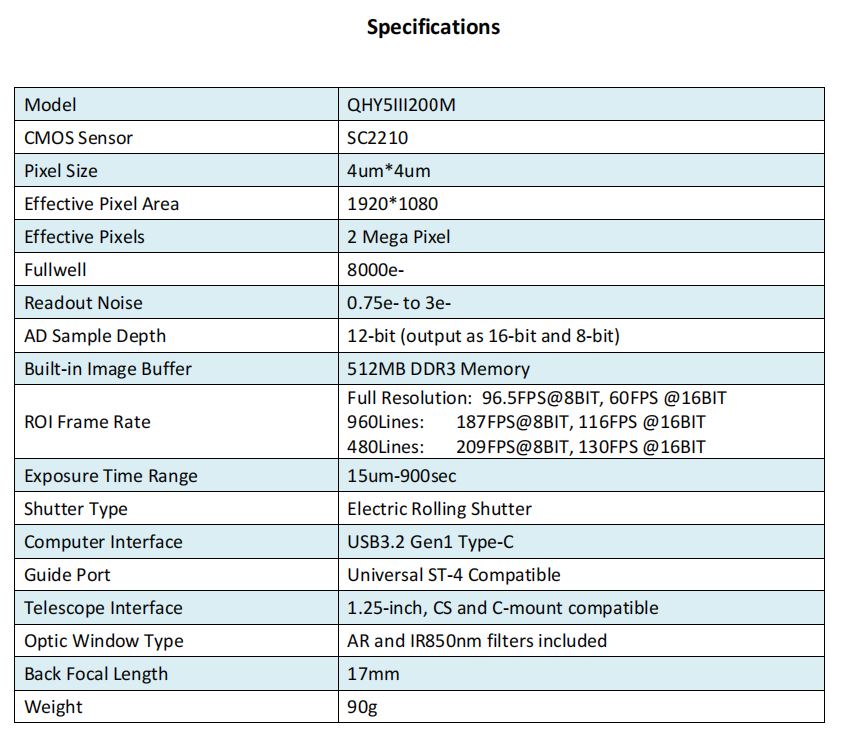
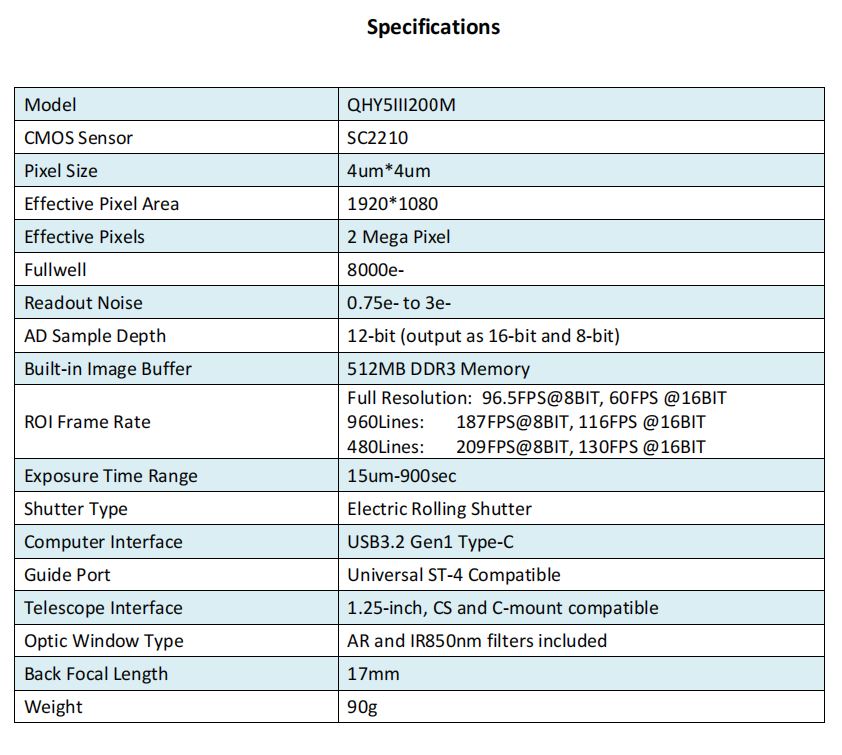
La 200M viene equipada con un sensor SC2210 con un tamaño de pixel de 4um y unas dimensiones de 1920*1080. Tiene un ruido de lectura de 0.75e – 3e y una profundidad de 12 bits. Gracias a sus 512MB de memoria DDR3 y su interfaz USB3.2 ofrece tasas de 96.5FPS a 8BIT o 60FPS a16BIT en resolución completa llegando hasta los 209 FPS a 8 bits o 130 FPS a 16 bits trabajando con ROI de 480 líneas.
Pros y contras de la QHY5III200M
Aunque se trata de una cámara pensada para astrofotografía planetaria y guiado creemos que es en este último campo donde destacan sus fortalezas ya que el tamaño de pixel de 2.9um de la 462C es más favorable para astrofotografía planetaria que los 4um de la 200M.
Hay que destacar también que esta cámara funciona a 12V con alimentación mediante un cable USB3.2 de tipo C más resistente que el anterior de tipo B que era bastante delicado en su conexión.
Sabemos que la cámara viene con, al menos, un filtro IR840 para obtener imágenes IR y que incorpora un nuevo sistema de adaptación de filtros de tipo C y CS (un estandar en lentes de videovigilancia y laboratorio) , además de mantener la posibilidad de roscar filtros de 1,25″.
Por el momento no tenemos reseñas ni precio de la QHY5III200M en tiendas oficiales por lo que tendremos que mantenernos atentos y a la espera para conocer más detalles de esta nueva cámara de QHY.
Gimbal manufacturer Zhiyun has announced the Smooth 5S single-handed gimbal stabiliser, with many enhancements over the previous release that are claimed to make it an ideal solution for larger and standard-sized mobile phones. The all-new 3-axis professional-level gimbal is packed with features designed to give filmmakers the creative edge in one small, highly portable package.
The Smooth 5S is the latest release from Zhiyun’s Smooth range and offers a range of upgraded features that are more attuned to the latest range of mobile phones.
The new gimbal is more powerful than ever and can cater to larger smartphones, offering superior stabilisation. New to the model is the ability to mount two modular fill-in lights to boos the already decent lighting power of the built-in lamp.
This innovative light design enables a fast solution to boost lighting power in darker locations and offers plenty of control over the brightness to enable you to capture the video you need for your production.
Other design changes include an axis alteration to enable a wider shooting angle and an intuitive control panel with integrated direct control dials and buttons to make adjustments and gimbal control quick and easy.
Xin Wang, Product Manager, Zhiyun, said: “our creative tools enable content creators to realise their filmmaking goals and allow them to explore the furthest limits of their creativity. With its innovative features and second-fill light, the Smooth 5S elevates your smartphone into the perfect one-person day-to-night filmmaking tool. It’s perfect for content creators or anyone wishing to express themselves creatively.”
New fill-in light
The Zhiyun Smooth 5S features a new fill-in light on its tilt axis. This offers a 5,000k colour temperature, 90+ CRI and 2W rater power output.
The new fill light is in addition to the built-in 300-lumen light that has featured on previous Smooth models and enables full 360° all-round lighting for areas up to 15 square metres. This light will enable you to boost detail in the shadows and increase contrast adn brightness wherever you’re filming and whatever the lighting conditions.
Unbreakable stabilisation
Updated magnetic steel motors powered by new algorithms help to provide shake-free footage for standard and larger mobile phones. The new wider phone clamp has also been designed to support phones attached with additional lens options.
New levels of control
The redesign of the axis setup means that the Smooth 5S’s rear motors have changed position to enable wider vision capture. This additional freedom of movement enables extremely wide-angled shooting and therefore puts more creative control into the hands of the creator.
The direct control feature on the grip of the gimbal enables the user fast access to options and settings and options to adjust and change parameters. Visual shooting modes and the round cap joystick enable easy single-handed control.
Up to 25 hours of use
One of the big features of the compact Smooth 5S is the outstanding battery life that Zhiyun is quoting with the release. Taking just 2 hours for a full charge via the PD fast-charging USB Type-C port, the Smooth 5S provides up to 25 hours of non-stop shooting.
Full compatibility with the ZY Cami App
As you’d expect, the Smooth 5S is fully compatible with the ZY Cami app and offers multiple templates, filters, music, transitions, and stickers, including:
Multiple quick-switch shooting modes, including PF, L, F, POV
Zoom and focus switch support and focal length adjustment via the control wheel enable entry-level to film professional dolly zoom effects.
Smart Follow – secures the spotlight for your subject. Remotely control the camera via gestures.
MagicClone Pano, Slow Motion, Timelapse features.
Zhiyun’s StaCam professional app is an addition designed for dedicated video filming. This app has a simple multifunctional interface that will enable you to shoot video with a cinematic feel.
Dimensions and weight
Dimensions 311 x168 x 52mm
Weight 660g.
Zhiyun Smooth 5S Pricing and availability
Zhiyun Smooth 5S is available for £169 from the Zhiyun or Amazon store.